When Katsuhiro Otomo created the now-incredibly-famous manga Akira (1982-1990), this is what he did to Tokyo:1

Only a few years earlier, Otomo published Domu: a Child’s Dream 童夢 (1980-1981), a grim tale set at the fictional Tsutsumi Danchi, a housing complex where thirty-six people had died from suicide in 3 years. 2 In short, if Katsuhiro Otomo sets his sites on you, the results may not be pretty.
Tsutsumi Danchi is said to be modeled after Kawaguchi Shibazono Danchi 川口芝園団地, 3 4 5 the primary topic of this post (as well as Takashimadaira Danchi).6 7
Here are some scenes of Tsutsumi Danchi from the manga:8
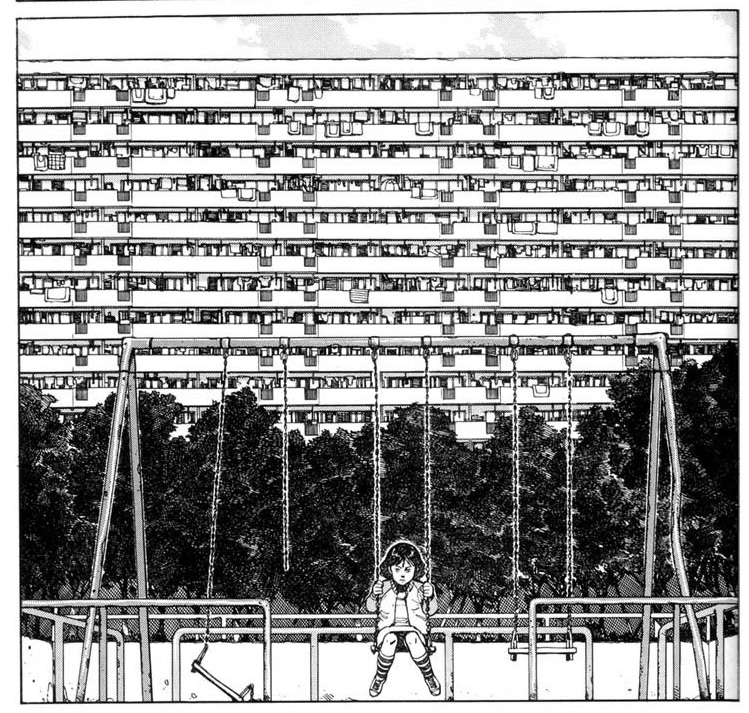
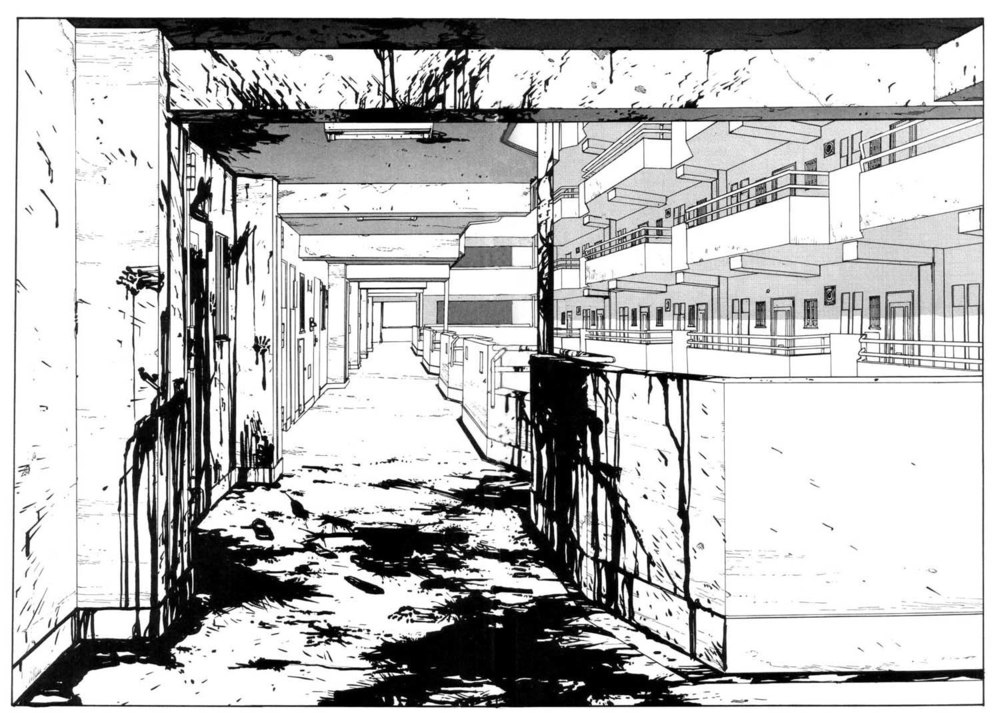
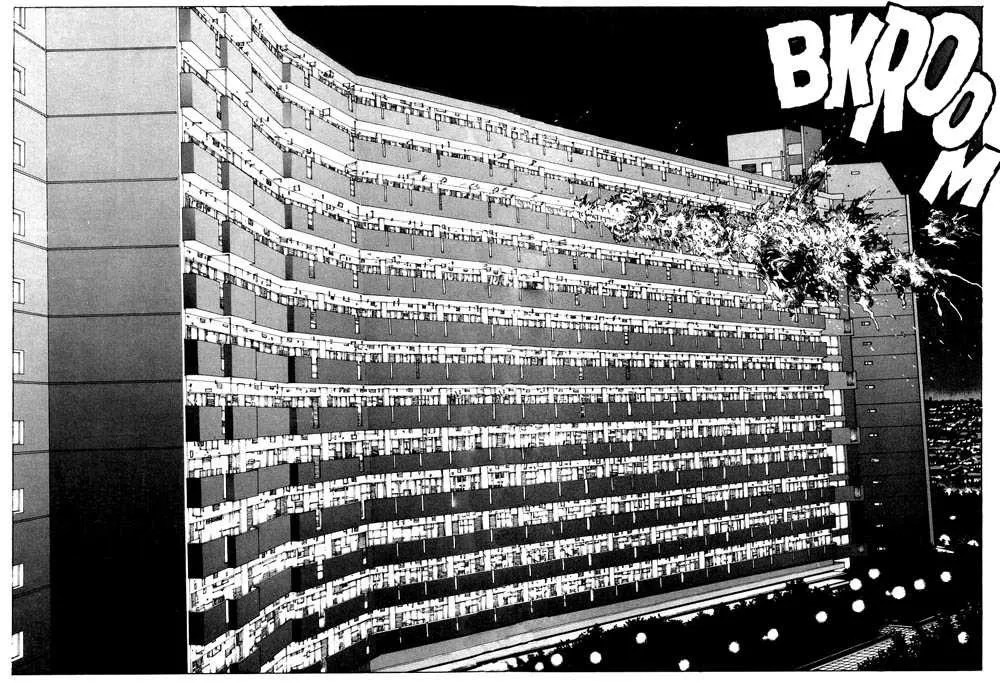
So what of the real Shibazono Danchi?
Kawaguchi Shibazono Danchi was built in 1978 and has been included in the Urban Renaissance Agency’s list of 100 public housing projects that are culturally or historically significant: 9
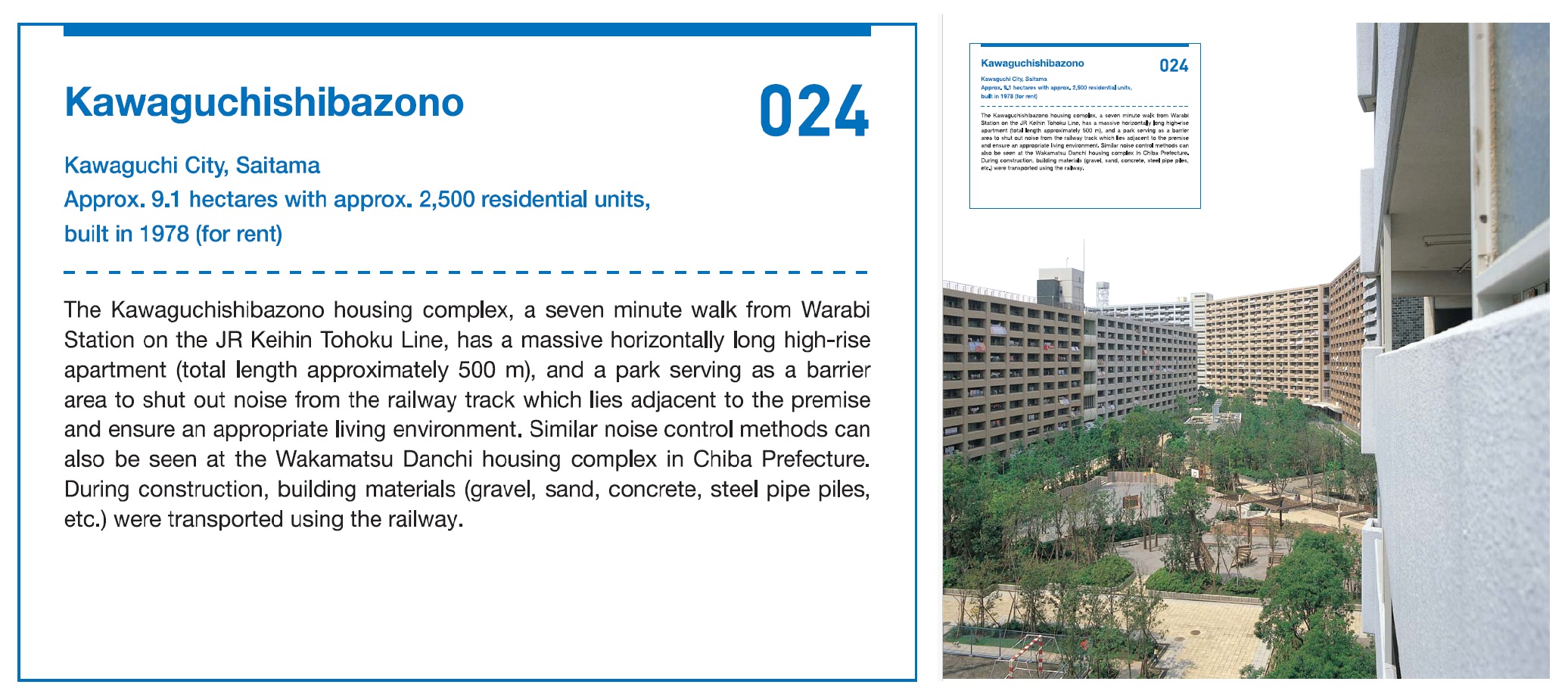
The text reads:
The Kawaguchishibazono housing complex, a seven minute walk from Warabi Station on the JR Keihin Tohoku Line, has a massive horizontally long high-rise apartment (total length approximately 500 m), and a park serving as a barrier area to shut out noise from the railway track which lies adjacent to the premise and ensure an appropriate living environment. Similar noise control methods can also be seen at the Wakamatsu Danchi housing complex in Chiba Prefecture. During construction, building materials (gravel, sand, concrete, steel pipe piles, etc.) were transported using the railway.
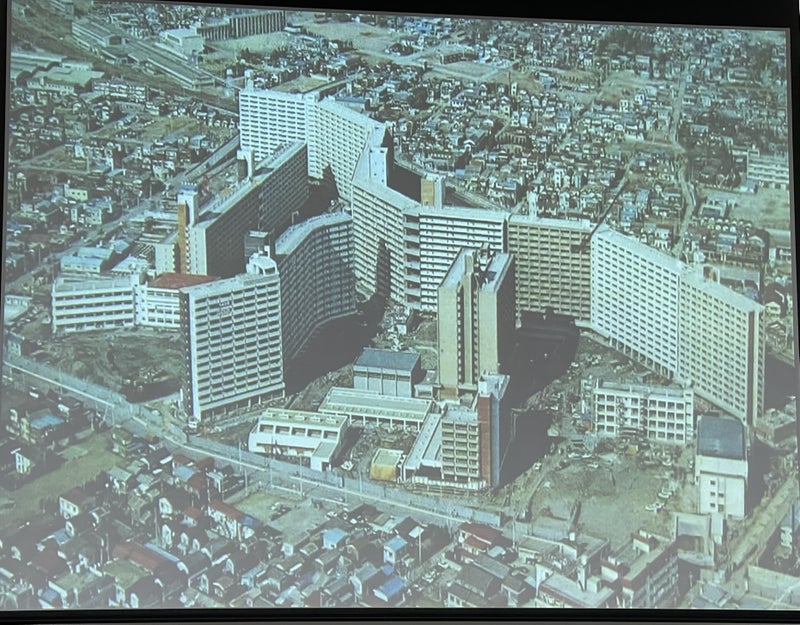
And it’s MASSIVE.

Above is the main building of Shibazono Danchi, which measures approximately 530 meters along its zig-zag shape. The danchi is located next to train tracks, not far from Warabi Station 蕨駅, in Saitama (Map)
The main building is so large it is difficult to properly capture the immense size in a single picture:

The following is the best photo I’ve seen that conveys the building’s size:10
Challenges
Shibazono Danchi is mentioned periodically in the press due to its high concentration of foreign residents (mostly Chinese), and the somewhat strained relationship between Japanese and foreign residents. These challenges are not unique to Shibazono Danchi, 11 but are likely amplified by the danchi’s size and density, as well as the increasing age of the danchi’s Japanese residents.
Here’s a sample:
(1) ‘Just like in China’ — Chinatowns proliferate around Tokyo; Nikkei (via Reddit):
Kawaguchi Shibazono Danchi is managed by Urban Renaissance Agency (UR), a semi-governmental institution that develops rental housing. The complex has 2,454 units, about half of which are occupied by Chinese residents.
Shibazono Danchi, a public housing complex in Greater Tokyo, has been famous nationwide because of the concentration of Chinese immigrants. Built in 1978 with nearly 2,500 units, Shibazono has easy access to the centre of Tokyo. It was one of many ordinary Danchi, Japan’s public housing complexes. However, as Japanese residents grew older and decreased in number, Chinese immigrants started flowing into Shibazono Danchi in the 1990s, outnumbering Japanese residents since 2016. Many of these Chinese immigrants are IT professionals working in Greater Tokyo. As the number of Chinese residents increased, Chinese-run businesses opened in the shopping street of Shibazono Danchi, which has made some feel like it has turned into an ethnic neighborhood.
(3) Danchi highlight complexity of Japan’s interculturalism (The Japan Times) 12
Stroll through Shibazono Danchi in Kawaguchi, Saitama Prefecture, on a weekend and you will find children shrieking with glee…But what one might find unusual about the scene is that the children speak Mandarin, sometimes interspersed with Japanese, as their mothers converse in rapid-fire Chinese.
…
“Half of the 5,000 or so residents of this danchi are foreign nationals under 30, while the remaining half are Japanese people about 60 or over,” said Shibazono resident Hiroki Okazaki, 37. Over 90 percent of the non-Japanese residents are believed to be Chinese, he added.
…
In Shibazono’s case, a tabloid magazine reported in 2010 that the complex, situated in the city’s Shibazonocho district, was turning into a “China Danchi,” detailing complaints from Japanese about how foreign tenants failed to heed basic rules on how to throw away their trash, in some cases allegedly tossing litter from their windows.
…
“The situation has improved” over the past decade or so, and waste and noise issues are not as prominent as before, said Katsuji Nirasawa, a 74-year-old resident who leads the danchi’s resident association.
…
In 2012, the danchi’s management company agreed to station a Chinese interpreter at the complex. Events were planned to promote understanding between residents, culminating in the 2015 launch of the Shibazono Kakehashi Project. Its aim was to bring residents together, regardless of age or nationality, for gatherings and events on a more regular basis. It also sought fresh perspectives from the student volunteers themselves.
And yet, despite the drastic improvement in relations, residents still seem to maintain a quiet distance from one another.
“The thing is, the Japanese and Chinese residents don’t ‘live together,’” she said, using the Japanese word kyōsei, a term that implies a certain level of good relations and mutual dependence.
“We merely coexist.”
Despite the challenges, efforts have been underway for many years to help bridge the gap between Japanese and foreign-born residents.
One effort that is cited is the Shibazono Danchi Neighborhood Association,13 which was recognized by The Japan Foundation Prizes for Global Citizenship in 2017.
Another example is the Shibazono Kakehashi Project, an organization, mainly run by college students, that organizes language learning and other cultural awareness activities. 14
Links:
- Life at the Kawaguchi Shibazono Housing Complex 川口芝園 団地のくらし (Urban Renaissance website)
- For additional posts about danchi in greater Tokyo, see: the tokyo files: danchi 東京団地萌え
- Domu: A Child’s Dream by Katsuhiro Otomo (Nihon Distractions)
- Shibazono Danchi: a Japanese public housing complex as part of the migration infrastructure for Chinese IT workers
- Kawaguchi: A Place with a Deeper Kind of Chinatown
- Comparing “Innocents” and Katsuhiro Otomo’s “Domu”! The climactic scene of “Domu,” featuring a swing, is revealed.
- Domu Manga (Wikipedia)
- Saitama Prefectural Housing Supply Corporation: Prefectural Housing | UR Kawaguchi Shibazono Housing
- Not far from here is the Tatekawa River 竪川, not to be confused with the river of the same English name in Koto-ku
Footnotes:
- Where did the explosion start in Akira? ↩︎
- Domu: A Child’s Dream: “Thirty-six people have died in apparent suicides in less than three years in the Tsutsumi Housing Complex, a social housing development where a diverse range of characters reside. Inspector Yamagawa senses a pattern in the alleged suicides and, accompanied by Inspector Takayama, embarks on an investigation. Yamagawa even brings a psychic to the complex, but upon arrival, she refuses to enter, claiming there are bad energies in the place, and more people will die. The prediction comes true, and Yamagawa can only find a supernatural explanation for the deaths in the Tsutsumi Complex.” ↩︎
- Also known referred to as UR川口芝園住宅, as this danchi is administered by the Urban Renaissance Agency (UR) ↩︎
- Codan Walker: 大友克洋氏の漫画「童夢」の舞台となったことで有名な団地です。 (This housing complex is famous for serving as the setting of Katsuhiro Otomo’s manga *Domu*.) ↩︎
- Dōmu by Katsuhiro Otomo. From Reality to the Imaginary, Architecture As an Integral Part of the Narrative: “Two years before giving life to the world of Akira, [Katsuhiro] Otomo laid the foundations for the creation of a coherent urban scenario in Dōmu, A Child’s Dream. Dōmu’s story is entirely set in an intensive Japanese condominium, a huge snake building called Tsutsumi Danchi. An architecture that Otomo represents in too much detail to be his own invention. The reference for Tsutsumi is in fact the Shibazono Danchi, a building of intensive housing located in the Saitama prefecture.” ↩︎
- Takashimadaira was at one point infamous for its suicides. See: Takashimadaira Danchi 高島平団地 ↩︎
- Theories of Mixed-Residence Society 15: Katsuhiro Otomo, *Domu* (Futabasha, 1983) 混住社会論15 大友克洋『童夢』(双葉社、一九八三年) ↩︎
- Domu photos: Superpowers and Concrete Towers: Katsuhiro Otomo’s ‘Domu: A Child’s Dream’ ↩︎
- 100 Danchi 団地100 (PDF); 100 Danchi 団地100 (website) ↩︎
- Shibazono Danchi photo source: From “Coexistence” to “Living Together”: Community Building Involving Foreign Residents 「共存」から「共生」へ ~外国人住民を交えた地域づくり~ ↩︎
- Warabi and Saitama as a whole are dealing with challenges related to a higher proportion of foreign residents; for example: Saitama Prefecture Sees Surging Demand for Language Support Among Non-Japanese Students ↩︎
- Archived version of the Japan Times article ↩︎
- What sort of multicultural society can we create in the near future by continuous action?: The Japan Foundation Prizes for Global Citizenship support organizations throughout Japan that conduct international cultural exchange activities. In fiscal 2017, three organizations were selected as recipients. Shibazono Danchi Neighborhood Association in the city of Kawaguchi, Saitama Prefecture focuses on exchange between Japanese residents and foreign residents. ↩︎
- PanSIG Journal, 2020: One example worth mentioning is the Shibazono Kakehashi Project, an organization mainly run by college students in Kawaguchi, Saitama Prefecture. In the town of Shibazono, foreign residents have outnumbered Japanese residents since 2016, according to the Shibazono Kakehashi Project (n.d.). The Shibazono Kakehashi Project has been run mainly by college students to promote communication among the residents of the town, and their activities are not limited to language learning. Nevertheless, it is a good example where Japanese college students are involved in activities with foreign residents in the local community and raise cultural and language awareness.” ↩︎


[…] Kawaguchi Shibazono Danchi 川口芝園団地, home of one of the largest danchi buildings in the greater Tokyo areas […]
[…] For other depictions of the greater Tokyo area in the manga of Katsuhiro Otomo, see: Domu: ‘A Child’s Dream’ came true (sort of): Kawaguchi Shibazono Danchi 川口芝園団地: […]